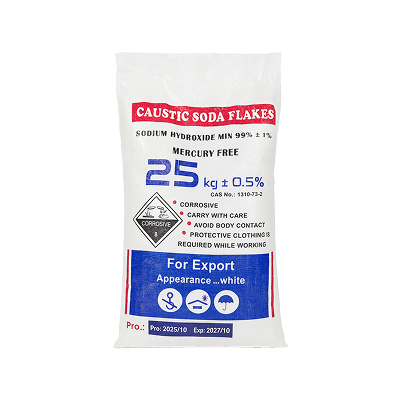


Liquid Caustic Soda
Key Feature
- High purity (98–99%)
- Suitable for a wide range of industrial applications
- Strong alkalinity
- Fast dissolution in water
- Stable and safe packaging options
Product Overview
Appearance: Liquid
Chemical Name: Sodium Hydroxide
Chemical Formula: NaOH
Packaging Type: In drums/cans
Definition and Applications:
Pure sodium hydroxide is a colorless, crystalline solid that melts at 318 °C without decomposition. It is highly soluble in water, has a lower solubility in ethanol and methanol, but is insoluble in ether and other non-polar solvents.
Similar to the hydration of sulfuric acid, dissolving solid sodium hydroxide in water is an extremely exothermic reaction that releases a large amount of heat, posing a safety hazard due to the possibility of splashing. The resulting solution is usually colorless and odorless. As with other alkaline solutions, it becomes slippery upon contact with skin.
Sodium hydroxide reacts with protic acids to produce water and its associated salts. For example, when sodium hydroxide reacts with hydrochloric acid, sodium chloride is formed.
NaOH (aq) + HCl (aq) → NaCl (aq) + H 2 O (l)
In general, such neutralization reactions are represented by a simple net ionic equation:
OH – (aq) + H + (aq) → H 2 O (I)
This type of reaction with a strong acid releases heat and is therefore exothermic. These acid-base reactions can also be used for titrations. However, sodium hydroxide is not used as a primary standard because it is hygroscopic and absorbs carbon dioxide from the air.
Caustic soda is a white, hygroscopic substance. It dissolves readily in water, forming a soft, slippery, and soapy-feeling solution. It has an irritating effect on human tissue. In laboratories, it is used to capture acidic gases such as CO2. In industry, it is used in the production of many chemicals, in the artificial silk, soap, paper, paint, and detergent industries, and in petroleum refining. When it reacts with water, its temperature rises to approximately 50 degrees Celsius in about 5 minutes and remains hot for about 15 minutes.
Areas of Application
- (For acid control, odor removal, pipe cleaning, and pH balancing)
- As an adhesive, in heat-sensitive printing, on newsprint)
- In the production of sodium aluminate, sodium cyanide, silicate, polycarbonate, titanium oxide, and zeolite.
- In the final product, it is used for removing residues and whitening.
- STTP, Sodium Hypochlorite, is used in the manufacture of soap, oven and pipe cleaner.
- Sodium phenolate (used in the production of aspirin and antiseptics)
- In refining cooking oil, peeling fruits and vegetables, and freezing.
- In oil cleaning, water purification, and equipment cleaning.
- Starch, Caustic Soda, Water, Silicate: Used Together in Label Adhesive Manufacturing
- Starch, Caustic Soda, Water, Borax: Used Together in the Production of Corrugated Cardboard Adhesive
- Used in removing acid residues from refined products, extracting phenols, balancing pH in drilling mud, and removing calcium and bactericides in drilling.
- For filter cleaning (in filter pools) and cleaning acid units in mines,
- Additionally, caustic soda (sodium hydroxide) or lime (calcium hydroxide) is used to adjust the pH of the sodium cyanide.
- (For acid control, odor removal, pipe cleaning, and pH balancing)
- As an adhesive, in heat-sensitive printing, on newsprint)
- (In the production of sodium aluminate, sodium cyanide, silicate, polycarbonate, titanium oxide, and zeolite)
- In the final product, it is used for removing residues and whitening.
- STTP, Sodium Hypochlorite, is used in the manufacture of soap, oven and pipe cleaner.
- Sodium phenolate (used in the production of aspirin and antiseptics)
- In refining cooking oil, peeling fruits and vegetables, and freezing.
- In oil cleaning, water purification, and equipment cleaning.
- Starch, Caustic Soda, Water, Silicate: Used Together in Label Adhesive Manufacturing
- For filter cleaning (in filter pools) and cleaning acid units in mines,
- Additionally, caustic soda (sodium hydroxide) or lime (calcium hydroxide) is used to adjust the pH of the sodium cyanide.
Specifications
| Specification | Value |
|---|---|
| Purity (NaOH) | 98–99% |
| Sodium Carbonate (Na₂CO₃) | < 0.5% |
| Sodium Chloride (NaCl) | < 0.05% |
| Iron (Fe) | < 0.005% |
| Form | Flakes |
| Color | White |
| CAS Number | 1310-73-2 |
| industry | Agriculture & Industrial، Food & Beverage، Pharmaceutical |
| Material | Liquid |
Applications
Industries
- Detergent & Soap Manufacturing
- Oil & Gas
- Water Treatment
- Pulp & Paper
- Textile Processing
- Aluminum Industry
- Chemical & Pharmaceutical Manufacturing
Use Cases
- pH control and neutralization
- Acid removal and degreasing
- Pulping and bleaching processes
- Chemical synthesis (organic & inorganic compounds)
Related Products